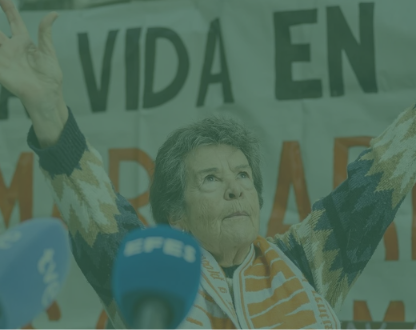
Image © Observatori DESCA
Maricarmen’s story | Spain: Forced evictions are preventable gross human rights violations. The human impact, the struggle for rights and collective resistance
As part of HIC’s #StopForcedEvictions campaign, we are sharing stories of forced evictions, their impact on people’s lives and the collective struggles to prevent them and demand justice. Because forced evictions are not inevitable. They are the direct result of political choices — and states have binding obligations under international human rights law to prevent them, and to ensure remedy and reparation when they occur.
What happened?
On 23 September 2026, Maricarmen, an 87-year-old woman with a disability, was evicted from her home in Madrid, Spain, where she had lived for more than 70 years. Despite having consistently paid her rent, she was forced to leave her home without an adequate housing alternative. She was hospitalised following the eviction and sadly passed away on 7 October 2026, before she could return home.
The drivers and impact
Maricarmen’s eviction took place in the context of growing housing speculation and the increasing vulnerability of tenants facing pressure from property investment companies — one of the most visible expressions of the financialisation of housing and the failure to regulate private actors that are driving forced evictions across cities worldwide.
For Maricarmen, losing her home meant losing not only a physical space, but the place where she had built her life and community ties over seven decades. Her case illustrates how forced evictions disproportionately affect the most marginalised and vulnerable — in this case, an elderly woman with a disability who could not afford an adequate housing alternative.
Legal protection and remedy: a failure of the Spanish Institutions
Housing rights organisations denounced the eviction as a violation of human rights, highlighting that it went ahead despite interim measures requested by the United Nations to prevent it.
Maricarmen’s case is a powerful reminder of one of the core principles of our campaign: an eviction may be authorised under national law and still constitute a forced eviction if it fails to meet international human rights standards. Compliance with domestic law is not enough. States have obligations to explore all feasible alternatives before carrying out an eviction, ensure adequate consultation and due process, provide adequate relocation, and guarantee access to remedy. None of these obligations were fulfilled in Maricarmen’s case.
Her story illustrates the gap between national legal procedures and the effective protection of housing rights — and the urgent need to close it, particularly for older people, persons with disabilities and all those who cannot afford an adequate housing alternative.
Community action and collective resistance
Maricarmen’s case mobilised neighbours, housing movements and civil society organisations, including the Sindicato de Inquilinas and Observatori DESCA, who supported her struggle and demanded stronger protections against forced evictions. Their collective action contributed to securing an agreement for her return home — although she sadly passed away before this could happen.
This is what our campaign is also about: the essential role of collective organisation, solidarity and community-led action in defending the right to adequate housing and demanding accountability from those responsible.
Beyond her individual case, housing rights organisations have advanced proposals known as the “Maricarmen decrees”, aimed at strengthening protections for vulnerable tenants and preventing further evictions — a concrete example of how individual cases can drive systemic change.
Why her story matters
Maricarmen’s story reminds us that preventing forced evictions requires more than legal recognition of rights. It requires timely and effective protection, political will, accountability and access to remedy. Remedy is not an afterthought — it is a core human rights obligation. Restitution, compensation, rehabilitation and guarantees of non-repetition are the minimum that affected communities are entitled to.
It also shows that change is possible — through collective resistance, community-led advocacy and the determination of those who refuse to accept that forced evictions are inevitable.
No one should lose their home. Prevent forced evictions. Ensure remedy for all.
As part of our collective #StopForcedEvictions campaign, we invite Members, partners and communities to share their experiences, struggles and collective solutions.
In Memory of Mari Carmen
We deeply regret the loss of Mari Carmen, the 87-year-old woman whose eviction became a symbol of Spain’s housing crisis. Her legacy—and that of all who lost their lives to the injustice of speculation—lives on, strengthening our commitment to defending human rights and the right to housing.
For more info:
- Learn more from our member, Observatori DESCA:
-
Read the analysis: El desahucio de Mari Carmen es una vulneración de derechos humanos
-
Impact report: Les organitzacions socials estimen que les mesures dels anomenats “decrets Mari Carmen” podrien beneficiar a 5,8 milions de llars
-
Watch: 5 key points to understand the Spanish government’s anti-eviction law proposal by Observatori DESCA
-
Help us change the narrative on forced evictions!
Share your story, testimony, or useful resources using this form: Share your story here
Other testimonies
El Jardín, Medellín, Colombia
Forced evictions: The human impact, the struggle for rights and collective resistance
Explore the campaign
Visit the campaign website to discover more testimonies, learn about collective struggles and explore actions to prevent forced evictions and ensure remedy and justice.